By
Vegard Blauenfeldt Naess
-
This is what Telescope can do for you
Climate risk means different things depending on where you sit.
For a real estate company managing hundreds of properties, the question is: what's already in my portfolio, how exposed are we, and what should we do about it? For a bank about to price a loan, an insurer underwriting a policy, or an investor evaluating an acquisition, the question is more immediate: is this property a good decision?
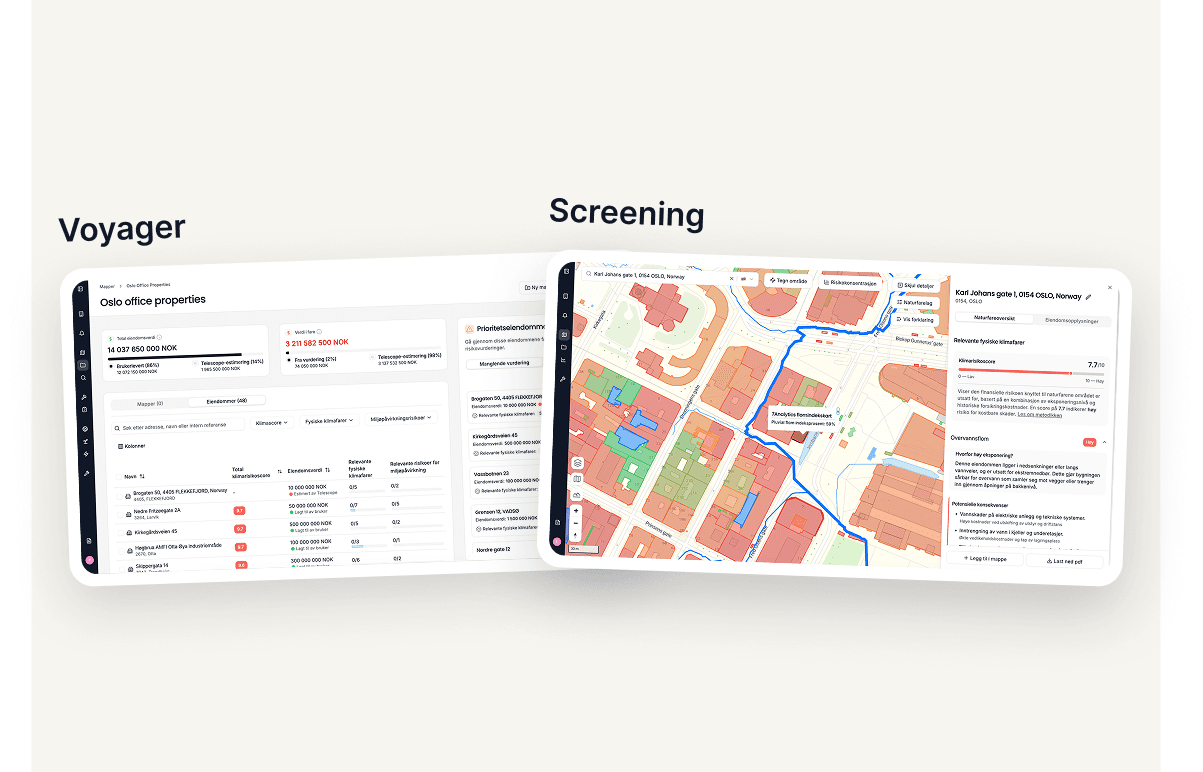
Same underlying risk. Completely different use cases. That's why Telescope is built around two distinct modules, each designed to answer a fundamentally different question.
If you manage a portfolio: Voyager module
Real estate companies face a challenge that isn't solved by screening one property at a time. You already own the assets. The risk is already there. The question is how exposed you are across the whole portfolio, and what to do about it.
Voyager is built for exactly this. It gives you a full overview of climate risk, transition risk, and biodiversity risk across your existing portfolio, whether that's 50 properties or 5,000. You can see where risk is concentrated, how it's distributed across asset types and geographies, and where your biggest vulnerabilities are.
But overview is only the starting point. Voyager is where you do the work: creating transition plans, setting up mitigation measures, assigning tasks to team members, tracking progress from planned to completed, and documenting everything for regulatory reporting. It's a management tool, not just a reporting tool.
Voyager covers three risk dimensions, each with its own dedicated dashboard:
Physical climate risk — flooding, storm damage, sea level rise, and other direct climate hazards affecting your assets
Biodiversity and nature risk — exposure to protected areas, vulnerable habitats, and nature-related risks that increasingly matter for regulation and financing
Transition risk — how regulatory changes, energy performance requirements, and shifting market expectations affect your portfolio's long-term viability. Create transition plans and track where you stand.
This separation matters. Physical, biodiversity, and transition risk require different responses from different teams. Voyager keeps them distinct so the right people can act on the right information.
Companies like Bane NOR Eiendom, Reitan Eiendom, Koteng Eiendom, Bertel O. Steen Eiendom, and Selvaag Eiendom use Voyager to manage climate risk across their portfolios.
See how the Screening module works in practice →
Voyager is for you if: You're a real estate company that needs to understand your existing exposure, create plans to reduce it, and track progress — systematically, at scale.
If you assess properties as you go: Screening module
Banks, insurers, and real estate investors face a different kind of problem. You're not managing a static portfolio. You're constantly making new decisions, and each one needs a climate risk perspective.
The Screening module is built for this workflow. It lets you screen individual properties quickly, so climate risk becomes part of your decision process, not an afterthought.
For banks, this means climate risk data at the point of credit assessment. A client advisor can screen any property in seconds, get a clear risk picture, and reference it in client meetings or credit memos. Risk and compliance teams get systematic, consistent assessments across the loan book.
For insurers, it means property-level exposure data to support underwriting. See flood, landslide, and storm surge exposure before you price a policy.
For real estate investors, it means screening acquisition targets for climate risk early in due diligence. Flag high-exposure properties before you commit capital.
But the Screening module isn't just per-property. At portfolio level, it provides concentration risk analytics and exposure overviews, giving leadership a birds-eye view of where risk clusters and how it's distributed across the loan book, policy portfolio, or investment portfolio. This is the kind of structured, documented analysis that holds up in a credit committee, board meeting, or regulatory review.
Regulatory expectations are tightening across all three segments. Banks are increasingly required to factor physical climate risk into credit decisions. Insurers need to understand risk concentrations. Investors are being asked by LPs to demonstrate that climate exposure is evaluated at the deal level. The Screening module helps meet these expectations without requiring deep climate expertise from the people doing the assessments.
Siva Eiendom and Coop Norge Eiendom are among the organisations using the Screening module to assess climate risk at the point of decision.
The Screening module is for you if: You're a bank, insurer, or real estate investor who needs to evaluate climate risk property by property and monitor portfolio-level exposure, integrated into your existing workflows.
Two modules, one platform
Both modules are built on the same underlying data and analytical engine. The risk models are consistent, the data sources are the same, and the methodology holds up to scrutiny — whether you're presenting to a credit committee, a board, or a regulator.
The difference is the use case. Voyager is for teams that need to act on risk: plan, assign, track, and report. The Screening module is for teams that need to assess risk at the point of a financial decision and monitor portfolio exposure over time.
Not sure which module fits your situation? We're happy to walk you through it.


Get the newsletter
Climate risk trends, product updates, and the methodology behind the numbers, straight to your inbox.
