By
Gustav Haaland
-
The growing insurance gap
Insurance is one of the quiet foundations of modern financial systems. But that foundation is shifting. Physical climate risk is making more assets harder — or impossible — to insure at affordable rates, creating a widening protection gap that now threatens banks, real estate values, and financial stability itself.
Insurance allows risk to be transferred, assets to be protected, and long-term investment to take place despite uncertainty. For insurers, banks, and real estate owners alike, the availability of insurance is a basic assumption that underpins underwriting, lending, valuation, and investment decisions.
That assumption is now under pressure. Across markets, physical climate risk is making more assets harder to insure. Premiums, deductibles, and coverage terms are becoming more restrictive, and in some cases insurance is no longer available at all. This widening insurance gap is not a temporary market adjustment. It is a structural signal that risk is starting to exceed what existing financial mechanisms can absorb.
The consequences extend beyond insurance balance sheets. Assets that cannot be insured are harder to finance. Real estate values become uncertain. Investment decisions are delayed or abandoned. The insurance gap connects insurers, lenders, and asset owners into a shared risk system — and understanding how it emerged is the first step to addressing it.
The insurance gap is widening across markets
Across markets, insurers are reducing exposure, tightening terms, or withdrawing from certain perils and regions. This is often framed externally as market failure or a lack of willingness to insure. Inside the industry, it is understood as something else entirely: a response to rapidly changing risk fundamentals.
Loss experience is deteriorating. Events are clustering. Correlations are increasing. Capital efficiency is under pressure. These are not theoretical concerns. They are showing up in combined ratios, reinsurance pricing, and portfolio volatility.
This is already visible in concrete market decisions. In 2023, State Farm stopped writing new homeowners' insurance policies in California, explicitly citing wildfire risk and rising catastrophe exposure, while Allstate paused new homeowners' policies in the state. These decisions did not eliminate insurance overnight, but they materially reduced capacity and signalled that insurability constraints were becoming structural rather than cyclical.
The insurance gap is not a failure of insurance discipline. It is the result of risk being discovered too late in the system.
What the insurance gap means in practice
The insurance gap refers to the growing share of losses that are no longer insured at an affordable price, or insured at all. In practice, this rarely appears as an immediate withdrawal of coverage. It emerges gradually through higher premiums, increased deductibles, narrower terms, exclusions for specific hazards or locations, and growing uncertainty at renewal.
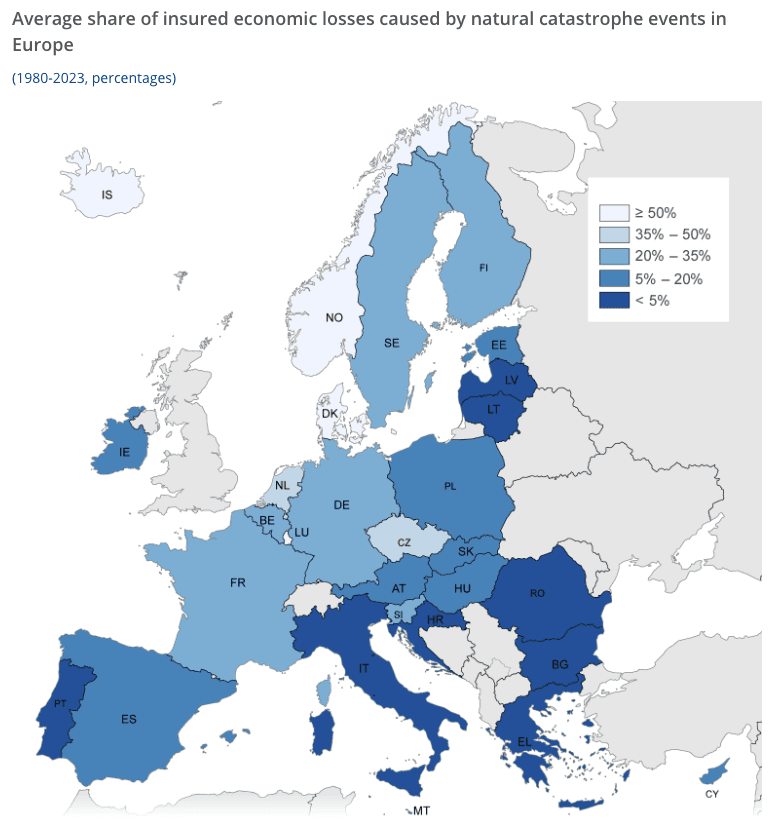
In Europe, this gap is now measured explicitly. Data published by the European Insurance and Occupational Pensions Authority (EIOPA) shows that only a fraction of economic losses from natural catastrophes are insured across most European countries, leaving households, companies, and public budgets exposed to growing residual risk.
Assets often become partially uninsurable long before coverage disappears completely. From an underwriting perspective, this creates instability not just at asset level, but across portfolios.
Historical data no longer predicts future losses
The widening insurance gap is not driven by a lack of sophistication in underwriting teams. It is driven by structural changes in the risk environment.
Historical claims data is becoming a weaker predictor of future losses as climate conditions diverge from the past. Extreme events are no longer independent; they are increasingly correlated across regions and perils. This undermines diversification assumptions that insurance pricing has relied on for decades.
At the same time, pricing faces hard constraints. There are clear limits to what households, companies, and public entities can pay. When expected loss exceeds affordability, pricing ceases to be an effective risk management tool.
Industry leaders have been explicit about this shift. Günther Thallinger, Member of the Board of Management at Allianz, has repeatedly highlighted that climate risk is now challenging the basic assumptions behind insurability itself, as correlation and systemic exposure reduce the effectiveness of traditional risk pooling.
Insurance constraints are becoming a systemic issue
The consequences of the insurance gap extend beyond insurance balance sheets. Assets that cannot be insured are harder to finance — a dynamic explored in depth in When collateral can't be insured: what the insurance gap means for credit risk. Infrastructure projects without coverage struggle to reach financial close. Investment decisions are delayed or abandoned.
European regulators are already treating this as a systemic issue. In December 2024, EIOPA and the European Central Bank jointly proposed an EU-level approach to reduce the economic impact of natural catastrophes, explicitly citing the growing insurance protection gap and the risk of losses shifting to banks, governments, and households.
The European Commission's Climate Resilience Dialogue has similarly brought insurers, policymakers, and stakeholders together to address why market-based insurance alone is increasingly insufficient to manage climate-related disaster risk.
Better tools earlier in the value chain
The insurance gap is not inevitable. It is a signal that risk is being identified too late - at renewal, at claims, or after loss.
Slowing the gap requires better tools earlier in the value chain: more consistent exposure data, clearer mapping of physical risk, and forward-looking insight that supports underwriting, pricing, and portfolio steering before risk becomes unmanageable.
For insurers, the question is no longer whether climate risk is real. The question is whether current tools are sufficient to manage it at the speed and scale now required — a challenge that extends to banks assessing credit risk and real estate owners managing asset quality.
A closing reflection
What happens to assets that can no longer be insured in an open market?
Which banks will finance assets where the collateral itself cannot be protected?
And what does this mean for a financial system built on the assumption that risk can always be transferred?
These are no longer theoretical questions. They point to a future where insurance becomes a scarce and strategic resource — and where earlier, better insight into physical climate risk determines who can continue to operate, and who cannot.
Sources and references
State Farm stops issuing new homeowners' insurance policies in California due to wildfire risk (2023), CalMatters https://calmatters.org/housing/2023/05/state-farm-california-insurance/
Allstate pauses new homeowners' insurance policies in California, Insurance Business https://www.insurancebusinessmag.com/us/news/breaking-news/allstate-stops-issuing-new-homeowners-insurance-policies-in-california-448162.aspx
European Insurance and Occupational Pensions Authority (EIOPA) — Insurance protection gap for natural catastrophes (dashboard) https://www.eiopa.europa.eu/tools-and-data/dashboard-insurance-protection-gap-natural-catastrophes_en
EIOPA & European Central Bank (ECB) — A European approach to reduce the economic impact of natural catastrophes (2024) https://www.eiopa.europa.eu/eiopa-and-ecb-propose-european-approach-reduce-economic-impact-natural-catastrophes-2024-12-18_en
European Commission — Insurance of climate-related disasters and the Climate Resilience Dialogue https://finance.ec.europa.eu/banking/insurance/insurance-climate-related-disasters_en


Get the newsletter
Climate risk trends, product updates, and the methodology behind the numbers, straight to your inbox.
