By
Vegard Blauenfeldt Naess
-
Why Climate Risk is a CFO Issue
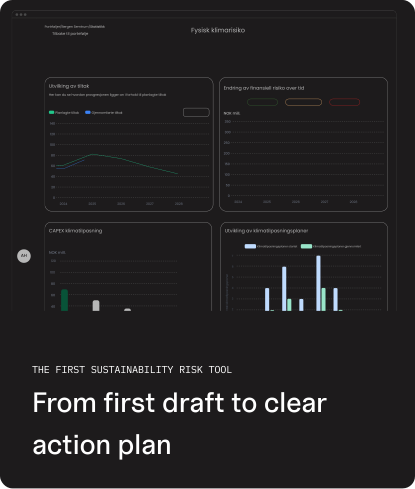
Climate Risk Isn’t Tomorrow’s Problem - It’s Already on Your Balance Sheet
In real estate, climate risk has moved from abstract headlines to concrete financial exposure.
Imagine a commercial building in Oslo. Two floods in three years. Insurance premiums spike. Tenants leave. The asset, once a prime investment, is now flagged by lenders.
This isn’t a one-off. Climate risk is now a direct threat to portfolio value. If you're a CFO, you’re already carrying that risk - whether your dashboard shows it or not.
The Hidden Costs You Might Be Missing
Energy-inefficient buildings lead to escalating utility costs which increases tenant risk as they need factor this into their operational expenses, link.
Properties in high-risk zones are increasingly suffering rising insurance premiums or loss of coverage, link.
Non-compliance with EU regulations limits access to green financing, link.
Investors Are Already Discounting Risky Portfolios
Funds apply climate risk discounts to valuations, link.
Lenders scrutinize ESG-alignment during portfolio reviews, link.
Real estate assessors are starting to differentiate asset values based on ESG KPIs, link.
Why Now? Regulations & Risk Converge
CSRD and EU Taxonomy mandate asset-level disclosures.
Stranded asset risk can devalue properties overnight.
Insurers are exiting high-risk zones, creating exposure gaps.
How Telescope Helps CFOs Take Control
Address-level risk scores (physical, transition, biodiversity).
Asset modeling to forecast retrofit ROI.
CSRD-aligned reports, ready for stakeholders.
Provide a better understanding of current and future portfolio risks.
Client Insight: Reitan Eiendom evaluated their entire portfolio in one month using Telescope - way faster than traditional consultancy timelines.
Worried about hidden liabilities on your balance sheet?
You know what to do!


Get the newsletter
Climate risk trends, product updates, and the methodology behind the numbers, straight to your inbox.
