By
Vegard Blauenfeldt Naess
-
Extreme weather ranks highest among long-term global risks
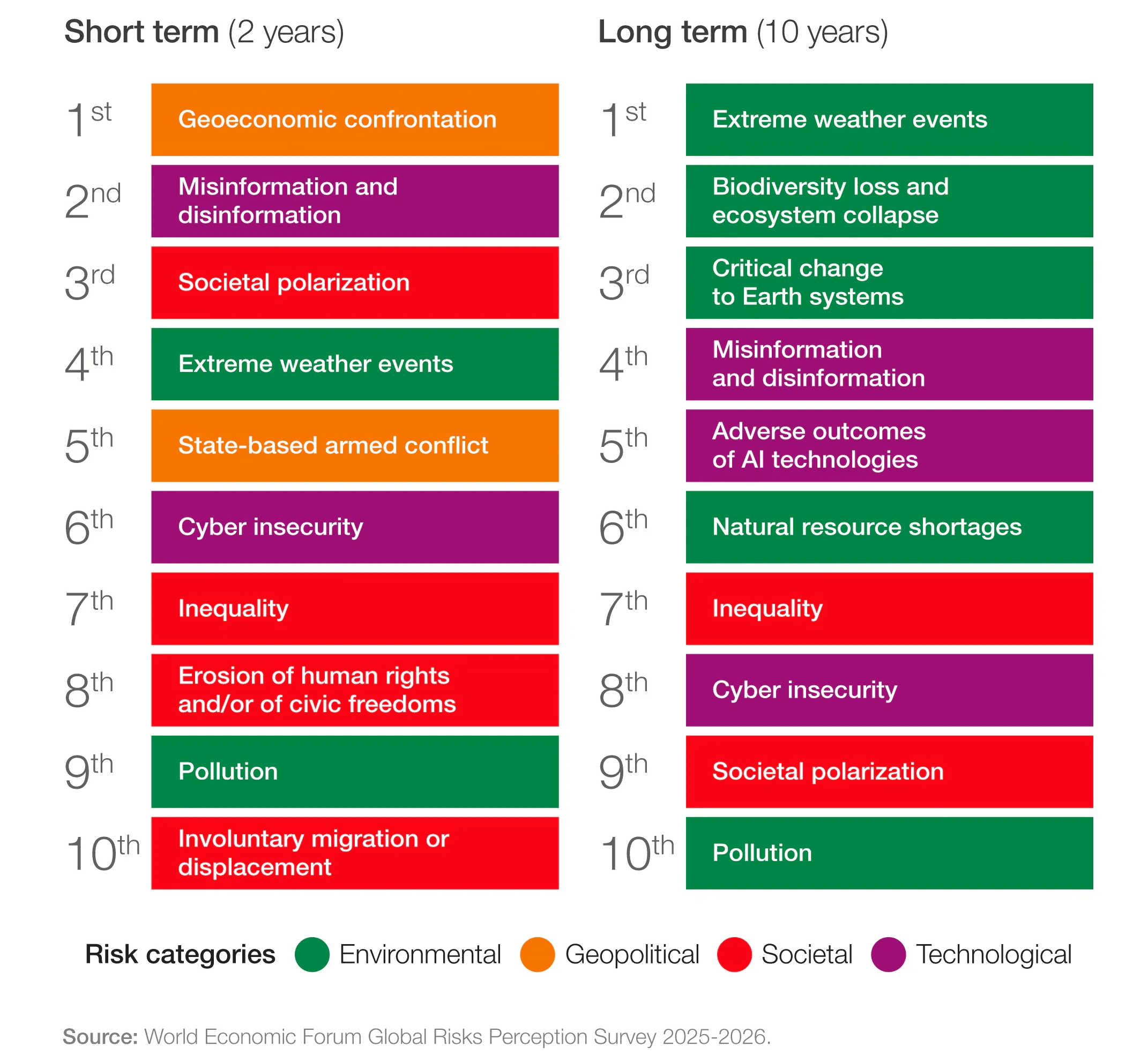
In the World Economic Forum’s Global Risks Report 2026, extreme weather events are ranked as the most severe global risk over a ten-year horizon, based on surveyed assessments of likelihood and potential impact. Biodiversity loss and ecosystem collapse follow closely behind.
The ranking reflects how global decision-makers currently prioritise risks looking ahead, rather than a statement about immediate outcomes or short-term developments. It captures expectations about where risks may become most consequential over time, given current trends and uncertainties.
For banks, real estate owners, and insurers, this matters because it provides insight into how physical climate risks are being weighted alongside other global risk factors in long-term assessments.
From environmental issue to economic consequences
That extreme weather ranks highest in the long-term global risk assessment reflects a continued broadening in how climate-related risks are analysed, particularly in terms of their economic and financial implications.
Floods, heatwaves, storms, droughts, and wildfires are increasingly analysed not only as environmental or humanitarian challenges, but also in terms of their potential to disrupt economic activity, damage assets, and affect financial stability.
The logic is relatively straightforward. Physical climate events can damage real assets directly. Buildings may be flooded, infrastructure disrupted, supply chains interrupted, and productivity reduced. Over time, insurance costs may rise, and in some cases coverage can become more limited.
When such impacts occur repeatedly rather than occasionally, they can influence balance sheets, investment decisions, and capital allocation across sectors. This helps explain why extreme weather is ranked above geopolitical conflict, cyber insecurity, and technological disruption in the World Economic Forum’s long-term outlook.
Biodiversity loss as a risk multiplier
Biodiversity loss and ecosystem collapse, ranked second in the long-term risk outlook, reinforces this perspective.
Healthy ecosystems provide services that underpin economic activity, including water regulation, soil stability, flood mitigation, and temperature moderation. When ecosystems degrade, they can amplify physical risks.
Flood impacts are often more severe in areas where wetlands have been reduced or removed. The loss of vegetation can increase the likelihood of erosion and landslides, particularly during heavy rainfall. At the same time, heat stress can become more pronounced as natural and urban cooling mechanisms weaken.
For financial institutions, biodiversity loss is therefore not only a sustainability concern, but also a factor that can influence the severity and frequency of physical climate impacts.
Implications for banks
For banks, the WEF ranking aligns with a broader trend in how long-term risks are being assessed.
Credit risk assessments have traditionally relied on historical data and financial indicators. Physical climate risks are increasingly being assessed alongside these established risk categories, particularly in longer-term portfolio analysis.
Assets located in flood-prone areas, coastal zones, or regions exposed to heat stress or landslides may face higher exposure to disruption, rising insurance costs, or changes in long-term value assumptions. As a result, physical climate exposure is becoming more relevant in discussions around credit quality and risk management.
Implications for real estate
For real estate owners and developers, the ranking highlights the growing importance of location-specific physical risk.
Properties exposed to repeated flooding, overheating, or infrastructure disruption may experience higher operating costs, reduced tenant attractiveness, or lower liquidity over time. Investors and lenders are increasingly interested in understanding these exposures, not only at portfolio level, but at the level of individual assets.
This contributes to a gradual repricing of risk over time, driven less by policy announcements and more by observable physical impacts and expectations of future exposure.
Implications for insurance
The insurance sector is directly exposed to these dynamics.
As extreme weather events become more frequent or severe, insurance pricing and coverage conditions may adjust accordingly. In some regions, this can affect the availability of coverage for certain risks.
These developments can have broader implications. Assets that are difficult or costly to insure may also become harder to finance, and more of the financial burden associated with extreme events may shift toward public budgets.
The Global Risks Report reflects growing awareness that insurance capacity is not unlimited, and that managing physical climate risk requires attention across the financial system.
From awareness to decision-making
The Global Risks Report does not argue for alarmism, but for realism.
The ranking of extreme weather as the most severe long-term global risk suggests that physical climate risks are becoming more relevant inputs to long-term planning, financing, insurance, and governance decisions.
For decision-makers, the central challenge is increasingly how climate-related risks are assessed and incorporated into existing decision-making processes. Attention is shifting away from high-level reporting toward more operational insight, including how physical exposure varies across locations and asset types.
Sources and references
World Economic Forum. The Global Risks Report 2026. World Economic Forum, January 2026.
Intergovernmental Panel on Climate Change (IPCC). Sixth Assessment Report (AR6): Impacts, Adaptation and Vulnerability.
Intergovernmental Science-Policy Platform on Biodiversity and Ecosystem Services (IPBES). Global Assessment Report on Biodiversity and Ecosystem Services.
European Environment Agency (EEA). Nature-based solutions and climate adaptation in Europe.


Get the newsletter
Climate risk trends, product updates, and the methodology behind the numbers, straight to your inbox.
